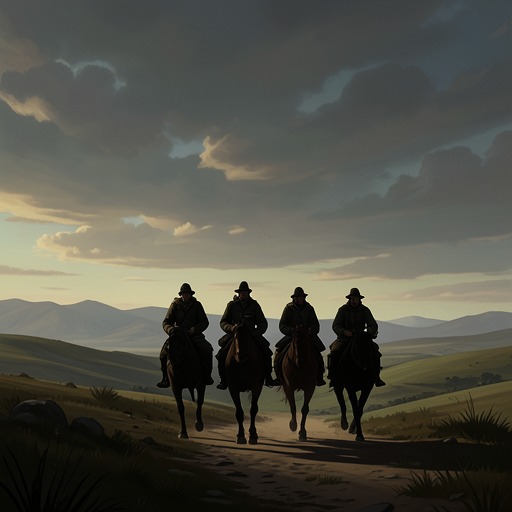
Montana Slim
On the RoadMontana Slim is a freight-hopping wanderer whom Sal Paradise encounters on his 1947 journey west. A small, dark man with a long, insinuating grin, he moves through the novel as both road comedian and guarded observer: he jokes about Sal’s shoes, speaks casually of following a man down an alley for money, and yet sends a tenderly polite postcard to his father. His brief presence gives the road’s marginal population a particular mixture of menace, humor, care, and departure.
Identity and Introduction
Sal meets Montana Slim aboard a freight train carrying a quiet sixteen-year-old blond fugitive and Mississippi Gene, the older hobo looking after him. Slim is described as a little dark man whose youthful appearance makes his age hard to guess. His grin seems to Sal long, goofy, and unnerving, while his sardonic remarks establish a manner that is deliberately hard to read. Unlike the silent Gene, who watches the fields for hundreds of miles, Slim periodically needles the other riders with insinuating questions and comments.
Slim’s name places him among the novel’s informal road identities rather than in a settled social world. His life is organized around freight trains, changing routes, and improvised plans: he says he is headed to Montana to see his father, expects to leave the train at Cheyenne, and will find another way north. The motion is practical rather than ceremonial. Each destination is a temporary answer to the question of where to go next.
A Roadside Pragmatist
Slim speaks plainly about the precarious economics of travel. When asked about money, he says he is not above following a man down an alley when he really needs cash. The admission gives his joking manner an edge: survival on the road may require opportunism, and his insinuation is not merely theatrical. At the same time, he talks without embarrassment about needing money and changing direction, treating these as ordinary conditions of itinerant life.
His advice reflects the seasonal labor landscape through which the travelers pass. At harvest time, he tells the Dakota boys that when work is finished where they are, they can keep moving north, following the harvest toward Canada. They barely heed him, but the advice shows that Slim understands travel as a sequence of work opportunities as well as rides and trains. His knowledge is practical and mobile, shaped by the routes available to men without a settled home.
On the truck heading across Nebraska toward Colorado, Slim rides with a group of high-school boys and other travelers as the road grows rough and the vehicle bounces between soft shoulders and deep ditches. The truck’s daring speed exhilarates Sal, who at last feels himself moving west, but Slim’s presence belongs to the same precarious passage: the journey’s freedom depends on other people’s vehicles, changing drivers, and roads that could easily throw the passengers into danger. The account makes travel vivid as shared transportation, not solitary mastery of the road.
Humor, Care, and Contrast
Slim’s humor is dry and personal. Seeing Sal’s battered shoes, their colored leather sticking up and toes showing through, he asks whether planting them in the ground would make something grow. The other boys laugh, and Sal joins them. The exchange turns the shoes into a shared joke rather than a private embarrassment, while Slim’s refusal to crack a smile preserves the teasing distance that defines him.
His behavior toward the younger fugitive reveals a quieter capacity for care. As the truck crosses the dark plains, the blond boy remains withdrawn, apparently preoccupied by whatever he is fleeing. Mississippi Gene leans toward him and speaks tenderly in his ear; Slim, by contrast, offers no such visible comfort. Yet his roughness does not make him the scene’s only figure of indifference: he travels alongside men whose vulnerability is plain, and his presence is part of a transient fellowship formed in cramped, uncertain passage. Sal, moved by the boys’ need, gives them cigarettes; Slim keeps his own pack to himself. That small contrast distinguishes his guarded self-sufficiency from Sal’s impulsive generosity without turning either gesture into a complete account of character.
Sal’s attention to Slim’s grin and insinuations makes him an unsettling comic foil to Gene’s patient stillness. Gene’s care for the fugitive is legible in a tender gesture, whereas Slim’s interior life remains concealed until the journey reaches Cheyenne. The later glimpse of filial feeling therefore revises, rather than erases, the first impression: the man who jokes, hoards his cigarettes, and talks of getting money by whatever means he must also maintains a connection to a father he intends to visit.
Cheyenne and the Postcard
Near Cheyenne, while asleep in the truck, Slim wakes and invites Sal to explore the town together before Sal continues toward Denver. Their arrival coincides with Wild West Week, when businessmen and their wives crowd the old wooden sidewalks in western costumes, blank guns go off, and saloons spill into the street. Sal finds the spectacle both exciting and ridiculous: the West’s proud tradition appears to have been reduced to a staged celebration. Slim’s invitation brings him into this episode as a companion, but neither man can remain for long; the Minnesota drivers are not interested in staying, and the travelers must part from the truck.
During the celebration, Slim gives Sal a postcard addressed to his father in Montana and asks him to find a mailbox. The card is signed Richard and promises that he will be home Wednesday, adding that everything is all right and hoping the same is true of his father. Sal reads it before mailing it, and the note changes his understanding of the man. The sardonic stranger’s private language is careful and affectionate, a sharp contrast with his insinuating grin and streetwise talk. The postcard does not explain their history or establish what awaits him in Montana; it reveals only the tenderness of the message and the fact that returning to his father matters enough to write about.
After the postcard, Slim goes into a saloon, and he and Sal later pick up two women and spend money at a nightclub. Sal spends nearly all but two dollars of what he has on drinks, swept up in the night and focused on the young blonde. The episode is not a settled destination for Slim but another passing arrangement of companions, money, and movement. His promised return to his father remains the clearest personal destination attached to him, even as the night’s improvised company pulls him temporarily elsewhere.
Narrative Role and Limits
Slim is a minor but memorable figure in the novel’s episodic road world. His appearances connect the abstract idea of restless travel to specific habits: riding freight trains, changing routes at Cheyenne, reading seasonal labor patterns, and negotiating companionship through jokes and small exchanges. He neither leads the journey nor transforms its course. Instead, Sal’s encounter with him enlarges the social field of the road, making visible the people whose plans and attachments are carried in the same vehicles as the narrator’s westward ambitions.
The postcard supplies Slim’s decisive counterpoint. His public manner invites suspicion and laughter, but the note to his father is restrained, polite, and domestic in its promise to come home. The novel leaves the promise unresolved; Slim disappears from Sal’s account without a reported arrival or final reconciliation. What remains is a brief portrait built on that tension: a man always moving on, yet still writing toward home.